
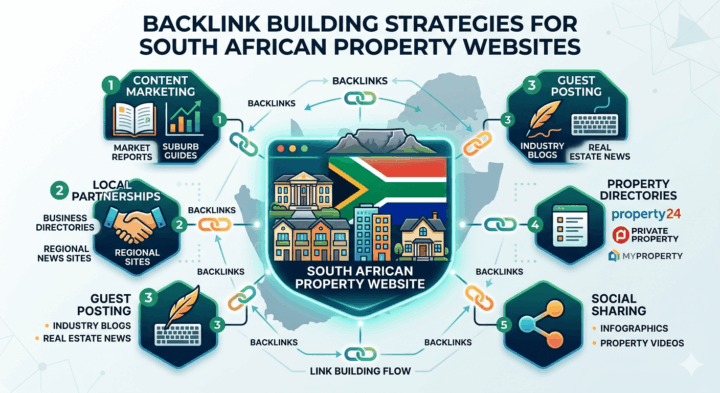
Picture two estate agents in Durban North. Both have websites targeting Umhlanga. Both have published suburb profile pages, both have fast load times and clean Core Web Vitals scores, both have optimised their listings with location-specific keywords. Yet one ranks consistently in positions 1–3 for property for sale Umhlanga while the other hovers around positions 8–12, invisible to the buyers who click only the top results.
The difference is not on-page. It is domain authority, the external trust signal built when credible South African websites choose to reference and link to your content. The first agent earned links from a local news outlet’s property feature, from the Umhlanga chamber of commerce directory, from a property data publication that cited their quarterly market analysis, and from a conveyancing attorney’s resource page. Together, those links tell Google that this website is a recognised, trusted participant in the SA property ecosystem.
Backlinks, links from other websites pointing to yours, remain one of Google’s strongest ranking signals. They cannot be manufactured overnight, and they cannot safely be bought. What they can be is systematically earned through citation-worthy content, strategic directory presence, media relationship building, and community participation. And here is the encouraging reality: in the South African property market, most of your competitors are doing none of this. The bar to meaningful backlink advantage is lower than it appears.
This guide maps the actual link acquisition opportunities available to SA property websites, the local directories, media outlets, industry bodies, data platforms, and partnership types that represent realistic, achievable targets in the South African digital landscape.
What Makes a Backlink Valuable: Quality vs Quantity
Before pursuing any link, understand the quality framework. Chasing volume over authority is one of the most common — and most wasteful, mistakes in link building.
The four factors that determine backlink value
Domain authority (DA) of the linking site. A link from BusinessTech.co.za (DA 75+) carries vastly more weight than a link from an obscure local classifieds directory (DA 8). Use Moz’s free Domain Analysis tool or Ahrefs’ Domain Rating checker to evaluate any site before investing time in outreach. Both offer free tiers sufficient for this purpose.
Topical relevance. A link from a South African property data platform, a local area lifestyle blog, or a conveyancing attorney’s website carries a stronger relevance signal than a link from a general business directory, even if the DA is similar. Google interprets topically relevant links as genuine endorsements from within your subject area.
Link placement. An editorial link embedded naturally within the body of an article is worth significantly more than a footer link or a links-page listing. The difference is editorial intent: Google distinguishes between links that are placed because the author judged the destination genuinely useful, and links that exist simply because someone paid for a directory entry.
Anchor text. The visible, clickable text of the link matters. A healthy link profile contains a natural mix of branded anchors (“Petzer Properties”), generic anchors (“this estate agent in Fourways”), and occasional keyword-rich anchors. A profile where the majority of backlinks use exact-match keyword text like “property for sale Sandton” looks manipulated and can trigger algorithmic scrutiny.
Backlink types to avoid
- Paid link insertion on low-quality directories or “sponsored” posts on link farms, Google’s Spam policies explicitly target paid link schemes and can result in manual penalties that are very difficult to recover from.
- Reciprocal link exchange programmes at scale, occasional reciprocal links between genuinely complementary businesses are fine; systematic “I’ll link to you if you link to me” programmes are not.
- Private Blog Networks (PBNs), networks of sites created specifically to manufacture backlinks. These are almost always identified and penalised by Google’s spam algorithms.
- Mass directory submissions to sites with DA below 15 that accept any listing, these are treated as link spam rather than legitimate citations.
- Over-optimised anchor text, if the majority of links pointing to your site use the same keyword phrase as anchor text, the pattern looks unnatural. Diversify.
The Low-Competition SA Opportunity
In markets like the US, UK, and Australia, property websites battle link-building budgets from national portals with dedicated SEO teams. In South Africa, most independent estate agent websites have fewer than 20 referring domains. A sustained effort targeting just 3–5 new quality backlinks per month can produce measurable ranking improvements in competitive suburbs within 3–6 months. The bar is genuinely lower than it appears.
The SA Backlink Source Tier List
The following table categorises available backlink sources by authority level, acquisition effort, and realistic time to result — giving you a prioritised framework to work from. Start with Tier 1 (most accessible, fastest to action) before investing time in Tier 2 and Tier 3 sources.
| Source Type | Authority | Effort | Speed | SA Property Context |
|---|---|---|---|---|
| Tier 1 Accessible — target first, available to every property website | ||||
| SA business directories (Brabys, SA Directories, Cylex SA) | Medium | Low | Fast | Free and paid listings available. Complete every field, thin listings are less likely to be indexed. |
| Google Business Profile (verified) | High | Low | Immediate | GBP links directly to your website and signals local authority. The single highest-return citation for any SA property website. |
| Property24 / Private Property agent profile | Very High | Low | Immediate | Both portals link to agent websites in their profiles. DA 70+ links. Ensure your website URL is correct and live in both. |
| Local chamber of commerce / business association | Medium | Low–Med | 1–4 weeks | Johannesburg, Cape, Durban, and Pretoria chambers all have online member directories. Join and request listing. |
| PPRA and property industry body listings | High | Low | 2–6 weeks | The PPRA website links to registered practitioners. Ensure your agency and individual agents are registered with a current website URL in the database. |
| Tier 2 Relationship-based — invest 2–4 hours per link; high relevance | ||||
| SA property data and market report citations | High | Medium | 2–8 weeks | FNB Property Barometer, Lightstone, PropData, and Rode Report regularly publish market data. Contributing original suburb analysis can earn citations and links from these platforms. |
| SA property media (PropertyProfessional.co.za, PropertiSA) | High | Medium | 4–8 weeks | Trade publications accept contributed articles and expert commentary. A 600-word opinion piece from a credentialed SA agent on a suburb trend earns a byline link. |
| Local lifestyle and neighbourhood blogs | Med–High | Medium | 2–6 weeks | Joburg-based community magazines and Neighbourhood.co.za forums link to quality area guides. Your location profile articles are the natural link magnet here. |
| Conveyancing attorneys and bond originators | Med–High | Medium | 2–6 weeks | A mutually beneficial referral relationship: an attorney who refers clients for property searches benefits from linking to a reliable property resource. Earned through professional networking. |
| Property investment and financial planning blogs | Med–High | Medium | 4–8 weeks | SA property investment blogs (BuyRentKeep, Wealth Migrate) accept expert commentary on suburb investment returns in exchange for substantive, original content contributions. |
| Tier 3 Editorial and digital PR — hardest to earn; highest authority and impact | ||||
| BusinessTech, MyBroadband, Daily Maverick property section | Very High (DA 70–90) | High | Weeks to months | SA’s highest-authority online media. Earn links by providing quotable expert commentary on property market trends, housing affordability, or PropTech developments. |
| Fin24 / Moneyweb property editorial | Very High (DA 75+) | High | Weeks to months | Financial media covers property investment extensively. An agent with original suburb price trend data, yield calculations, or rental market insights can earn editorial mentions and links. |
| Original data and research reports | Varies by pickup | Very High | 1–3 months | A “Sandton Property Market Report 2026” with original analysis and data will be cited by other publications if it contains genuinely useful information not available elsewhere. |
| HARO and Connectively (media request platforms) | Varies (DA 40–90+) | Med–High | 2–6 weeks per response | Connects journalists with expert sources. SA journalists increasingly use these platforms for property market quotes. Responding to relevant requests earns author citations with backlinks. |
Strategy 1: Complete Your SA Directory and Citation Profile
This is the fastest, most accessible win available to any SA property website. Most agents have an incomplete or entirely absent citation profile across the directories and platforms Google uses to validate local business legitimacy.
NAP Consistency is Critical
NAP stands for Name, Address, Phone number. Google uses NAP consistency across all your citations to validate that your business is legitimate and correctly located. Your business name, address format, and phone number must be identical across every directory listing. Even small variations — "011 234 5678" vs "+27 11 234 5678", "Street" vs "St", "Petzer Properties" vs "Petzer Properties (Pty) Ltd" — can dilute your local SEO signals. Establish a canonical NAP format and use it everywhere.
The SA property citation checklist (prioritised)
| Directory / Platform | Approx. DA | Action Required |
|---|---|---|
| Google Business Profile | N/A (direct Google signal) | Claim, verify, complete 100%. Most important citation of all. |
| Property24 agent/agency profile | 75+ | Ensure website URL is live. Add profile photo, bio, and correct address. |
| Private Property agent profile | 70+ | Same as Property24. Both are must-have citations. |
| PPRA registered practitioner listing | 65+ | Confirm registration is live and website URL is current in the database. |
| Brabys Business Directory | 45+ | Create or claim free listing. Complete address, phone, website, and description. |
| SA Directories (sa-directory.co.za) | 35+ | Free listing with website backlink. Takes approximately 15 minutes. |
| Cylex South Africa | 40+ | Free and paid options. Free listing is sufficient for citation value. |
| Local municipality business directory | 30–50+ | Many SA municipalities publish business directories. Check your specific municipality’s website. |
| Chamber of commerce member listing | 40–60+ | Johannesburg, Cape, Durban, and Pretoria chambers all have online member directories. |
| Yelp South Africa | 90+ | The DA is high (inherited from global Yelp). Listing takes approximately 10 minutes. |
| Hotfrog South Africa | 40+ | Free business directory with website link. |
| Locanto South Africa | 55+ | Relevant for both property listings and agency profiles. |
Strategy 2: Content-Led Link Acquisition (Linkable Assets)
The most sustainable long-term link building strategy is publishing content so useful, so data-rich, or so uniquely relevant to the SA property market that other websites link to it without being asked. These are called linkable assets — content specifically engineered to attract editorial citations.
The 5 content types that earn backlinks naturally in the SA property space
1. Annual suburb market reports. A “Sandton Residential Property Market Report 2026” containing original data on price trends, days on market, stock levels, and yield ranges will be cited by property media, financial blogs, and local news outlets seeking authoritative data. This is the highest-authority link-earning content type available to an SA property website. One report per primary suburb per year — time-intensive to produce, but earns compounding link value over years.
2. Suburb price history pages. A public-facing page showing historical average property prices in a specific suburb — sourced from Deeds Office data via Lightstone or PropData — becomes a reference that journalists, investors, and other agents link to when they need to cite historical price data. These pages rank well organically and earn links simultaneously.
3. First-time buyer guides for SA. A comprehensive, SA-specific guide to buying your first property — covering bond eligibility, FLISP, transfer costs, the OTP process — is genuinely useful resource content that financial bloggers, attorneys, and government information sites will link to. The SA home buying process is specific enough that generic guides do not serve this audience well, creating a genuine gap your content can fill.
4. PropTech and market trend analysis. An agent or agency that publishes substantive analysis of SA PropTech developments, interest rate impacts on buyer behaviour, or rental market dynamics earns citations from financial media (Moneyweb, Fin24) and property trade publications. This positions the agency as a thought leader rather than just a listings platform.
5. Neighbourhood lifestyle and infrastructure guides. Well-researched area guides covering schools, transport, development plans, and lifestyle features earn links from neighbourhood Facebook groups, school websites, and community organisations. These are topically relevant links from sites Google associates with the geographic area — high local SEO value, and a natural extension of your existing location profile content.
Strategy 3: Digital PR and SA Media Outreach
Digital PR is the process of earning editorial mentions and links from journalists and media outlets by becoming a quoted expert source for property market commentary. It is the highest-authority link building strategy available to an SA property website — and the most underutilised by independent agents.
How SA property agents can become media sources
- Build a media contact list. Identify the property journalists and editors at BusinessTech, Daily Maverick, PropertyProfessional.co.za, Fin24, TimesLIVE, News24, IOL, and your local city-specific publications (Sandton Chronicle, Cape Argus, Mercury). Follow them on LinkedIn. Note the property topics they cover regularly and return to.
- Build quotable expertise in a specific niche. Journalists need sources who can speak credibly and specifically. “A Sandton estate agent” is far less quotable than “the agent who tracks every sectional title sale in Bryanston and Morningside monthly”. Define your data niche and build a reputation within it.
- Respond to journalist requests via HARO and Connectively. These platforms allow journalists to post requests for expert sources. Property-related requests appear regularly. Agents who respond promptly with data-supported, quotable commentary earn backlinks when their contribution is used.
- Publish original data first. Before pitching a journalist, publish the analysis on your own website. “I’ve published a 6-month Constantia sales data analysis on my site — happy to share the key findings” is far more compelling than a vague offer to comment on the Cape Town market. The published piece itself earns links as other outlets discover and reference it.
Media Outreach Template — Offering Expert Commentary

Subject: Property market data: [Suburb] prices and trends, [Month] 2026

Hi [Journalist first name],

I'm [Name], principal agent at [Agency] specialising in [suburb/area]. I've been tracking sales data in [suburb] for [X years] and have just published an analysis of the [Q1/H1/last 12 months] market on our website.

Key findings that might be useful for your readers:
– Average price movement: [+X% / -X% year-on-year]
– Days on market: [average] vs [previous period]
– Notable trend: [one specific, quotable insight]

The full analysis is at [URL]. Happy to provide further data, additional context, or a comment for any property market piece you may be working on.

Regards,
[Your name]
[Agency name] | [Phone] | [LinkedIn]
The Response Rate Reality
A well-targeted media outreach campaign to SA property journalists will typically generate a response rate of 5–15%. This means sending roughly 10 well-crafted, genuinely relevant pitches to receive 1–2 responses. Do not be discouraged by early silence — journalists remember sources who send useful, specific data. Building a relationship over 3–6 pitches often results in a journalist proactively reaching out when they need a property comment.
Strategy 4: Broken Link Building (The Underused SA Tactic)
Broken link building is one of the most efficient link acquisition tactics available — it adds value to the linking site by fixing a broken link, and earns a backlink in return. In the SA context, this works particularly well for property-related resources that reference outdated information or defunct websites.
How to execute broken link building for SA property websites
- Install the Check My Links or Ahrefs SEO Toolbar browser extension on Chrome.
- Visit high-authority SA property-relevant websites: property investment blogs, financial advice sites, legal resource pages, local government housing information pages, and property industry body resources.
- Run the extension to identify broken links (404 errors) on these pages — links that point to content that no longer exists.
- When you find a broken link pointing to property market information, suburb guides, or homebuying resources, check whether your website has — or could create — a suitable replacement resource.
- Email the webmaster or content manager with a brief, helpful note: “Hi [Name], I noticed a broken link on your [page name] page — the link to [original resource] returns a 404. I have a similar resource on [topic] on our website that may be a relevant replacement: [your URL]. Thought it might be useful.”
- Typical conversion rate: 5–20% of webmasters will update the link when presented with a genuinely useful replacement — significantly higher than cold link building outreach.
Where to Find Broken Links in the SA Property Space
Focus specifically on: local municipality housing resource pages (often contain broken links to outdated government housing information), property investment blog round-ups (frequently link to resources that no longer exist), older BuyRentKeep or SA property forum posts that reference specific suburb data pages, and university accommodation advice pages that link to now-defunct student housing guides. The more specific and genuinely useful your replacement resource, the higher the acceptance rate.
Strategy 5: Local Partnership and Community Link Building
South Africa’s property market is fundamentally relationship-driven. Every link building strategy should be considered through the lens of: “Does this support a professional relationship that is valuable beyond the link itself?” The following partnership approaches deliver links as a byproduct of legitimate, mutually beneficial business relationships.
- Conveyancing attorney partnerships. Establish a referral relationship with 2–3 conveyancing firms in your primary area. Each firm’s website should include a resource page mentioning or linking to the property agents they work with regularly. A well-established attorney’s website may have DA 40–60 and high topical relevance.
- Bond originator partnerships. BetterBond, ooba, and independent bond originators all produce content for property buyers. A property agent who contributes original content — buyer guides, suburb analysis — to an originator’s blog earns a backlink from a highly relevant, medium-authority domain.
- Local schools and educational institutions. School websites in primary suburbs often have “neighbourhood resources” or “new to the area” pages. An agent who creates a “Moving to [Suburb]: A Family Guide” resource can request inclusion on the relevant school’s community page — a trusted, topically relevant link type.
- Sectional title managing agents. Body corporate and sectional title management companies produce content about the complexes they manage. A suburb overview covering sectional title complexes in a specific area is a natural link partner for these companies’ websites.
- Rental and letting platforms. If the agency handles both sales and rentals, partnerships with local letting management platforms (PayProp, Tenant Profile Network) create natural mutual linking opportunities.
Partnership Outreach Template — Complementary Business

Subject: Partnership opportunity — [Agency name] + [Their business name]
Hi [Name],

I'm [Name], principal at [Agency] — we specialise in [suburb/area] property and frequently refer clients to [Their business type: attorneys / bond originators / etc.] in the area.

I've just published a comprehensive guide to buying property in [suburb] on our website: [URL]

It covers [relevant topic: transfer costs / bond process / neighbourhood guide / etc.] and I think it would be genuinely useful to your clients. I'd appreciate it if you'd consider linking to it from your [resources / clients / neighbourhood] page.

In return, I'm happy to mention [Their business] as a recommended [attorney / bond originator] in that guide and on our referral page.

Would you be open to a brief call to discuss?

Warm regards,
[Your name]
[Agency] | [Phone] | [LinkedIn]
Measuring Your Link Building Progress
Link building without measurement is guesswork. The following four metrics give you a clear picture of whether your link acquisition efforts are generating real ranking impact.
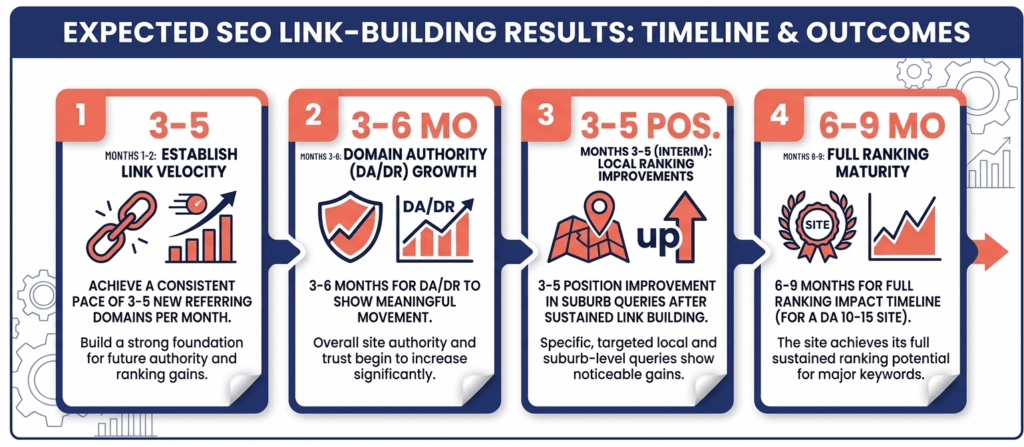
Referring domains: track in Ahrefs, Moz, or Google Search Console’s Links report. This is the most direct measure of link building progress. Target: 3–5 new referring domains per month for a growing property site.
Domain authority / Domain rating: the aggregate authority score from Moz (DA) or Ahrefs (DR). These scores increase slowly — expect meaningful movement after 3–6 months of consistent link acquisition. A property site moving from DA 15 to DA 30 over 12 months will typically see significant ranking improvements for competitive suburb queries.
Organic keyword ranking trends: track your 5–10 most important target queries monthly in Google Search Console’s Performance report. Ranking improvements of 3–5 positions in competitive suburban queries after 3–6 months of link building is a realistic expectation for most SA property sites.
Referral traffic in GA4: check Traffic Acquisition → Session source/medium to see which referring domains send the most traffic. High-DA links from SA property media may send only modest direct referral traffic, but deliver significant indirect ranking benefit through the authority signal they contribute.
The Link Building Timeline Expectation
Backlinks are the slowest-moving SEO variable. On-page changes can produce ranking improvements in 2–4 weeks. Backlinks typically require 2–6 months before their full ranking impact is measurable. An SA property website starting from DA 10–15 should expect to see meaningful suburban ranking improvements after 6–9 months of consistent monthly link acquisition targeting 3–5 new quality referring domains per month. This is not a quick win — it is a compounding advantage that becomes more powerful the longer you sustain it.
The Monthly Link Building Routine
Link building is most effective when it is a consistent monthly habit rather than an episodic campaign. The following four-hour routine, applied every month, will produce significant domain authority growth over a 12-month period — without requiring a dedicated SEO team or budget.
| Time | Activity | Expected Output |
|---|---|---|
| Hour_1 | Directory audit and citation cleanup | Identify and update any incorrect or missing NAP information across your citation profile. Add the site to any SA directories not yet listed on. Recurring monthly check once all 12 directories are live. |
| Hour_2 | HARO / Connectively monitoring and responses | Check for relevant journalist requests (property, finance, lifestyle). Write and submit 1–2 substantive, data-supported responses. Each accepted response earns 1 editorial backlink from a media outlet. |
| Hour_3 | Outreach, 3 personalised emails | Send 3 carefully targeted outreach emails: 1 media pitch (journalist + data), 1 partnership request (attorney/bond originator), 1 broken link replacement offer. Track responses in a simple outreach spreadsheet. |
| Hour_4 | Linkable asset progress | Write 500–700 words of a suburb market analysis, price history update, or area guide — the content that earns natural links over time. Aim to publish one completed linkable asset per quarter. |
The Compound Advantage of Starting Now
Most SA property websites have fewer than 20 referring domains. A competitor with 80 quality referring domains from credible South African sources will rank above almost any independently managed property site for competitive suburb queries — regardless of how strong the on-page SEO is. That gap is closed through sustained, relationship-based link acquisition. And in the SA market, most of those links are available to any agent willing to invest four hours a month, consistently.
The five strategies in this guide, citation profile completion, content-led acquisition, digital PR, broken link building, and local partnerships, are not a sequential programme. Run all five simultaneously at low intensity. The directory work happens once and is then maintained. The outreach is a monthly habit. The content investment compounds quarterly. After 12 months of this routine, your property website will have the external authority that on-page SEO alone can never deliver.
The agents who start this month will have a significant domain authority advantage over those who start in six months. In a market where most competitors are doing nothing, even a modest, disciplined effort stands out.

