
Two estate agents. Both in Sandton. Both spending R6,000 a month on paid advertising. Agent A puts everything into Facebook Ads, gets 45 leads, spends hours qualifying them, and signs one mandate. Agexnt B splits R4,000 to Google Ads and R2,000 to Meta retargeting, gets 18 leads, but signs three mandates from buyers who were already searching "property for sale Sandton". Same budget. Different platform strategy. Wildly different outcomes.
This scenario plays out across South Africa every month. The agents who blame the platforms are usually right that something is not working, but the failure is rarely the platform itself. It is the absence of a strategy: no conversion tracking, no dedicated landing page, no framework for deciding which platform to use and why.
The question “Should I use Google Ads or Facebook Ads for my property listings?” comes up constantly in SA property marketing WhatsApp groups, agency training sessions, and digital marketing consultations. Most estate agents have tried one or the other, often without a clear strategy, and many have concluded that paid ads simply do not work. In most cases, the platform worked fine. The setup did not.
This article answers the question definitively, with specifics the SA market demands: ZAR budget benchmarks, platform-specific cost-per-lead (CPL) ranges by property type, SA usage data, and a decision framework that tells you exactly which platform to use based on your situation, budget, and objective. Because for most SA estate agents, the right answer is not one or the other, it is a specific combination, and this article tells you exactly what that combination should look like.
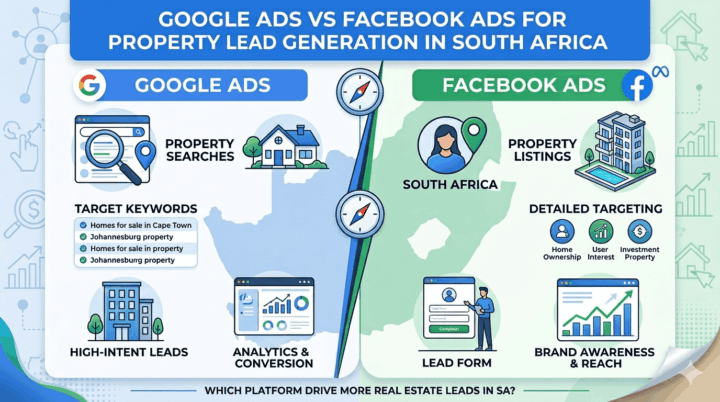
The Fundamental Difference: Intent vs Interruption
Before any meaningful comparison, you need to understand why these platforms generate leads differently. This single insight explains everything that follows.
- Google Ads = Intent Capture
You are finding buyers at the exact moment they are already searching for what you sell. - Meta / Facebook Ads = Audience Targeting
You are showing your property to people who match the profile of a likely buyer, before they have started searching.
Neither is inherently better. They operate at different stages of the buyer journey. A person who types “house for sale Rondebosch under R4 million” into Google is in active purchase mode. They are comparing options and will contact agents today. A person who sees a stunning Rondebosch townhouse in their Instagram feed on a Sunday afternoon may not have been thinking about buying at all — but your ad has planted a seed. That seed may become a lead in three weeks. Both leads have value. They require different follow-up strategies and different expectations around lead quality. Understanding this distinction is the foundation of every effective property advertising strategy in South Africa.
Head-to-Head Comparison Across 8 Dimensions
The table below compares Google Ads and Meta Ads across the eight dimensions that matter most for SA property lead generation. The verdicts are deliberate, this is a comparison article, and vague non-answers serve nobody.
| Dimension | Google Ads | Meta Ads (Facebook/Instagram) | SA Property Verdict |
|---|---|---|---|
| Lead Intent | High — searcher is actively looking for property | Medium — interest-based; buyer may not be in market yet | Google wins for immediate mandate-ready leads |
| CPL (buyer leads) | R450–R1,400 per lead depending on suburb and competition | R180–R600 per lead — lower CPL but lower average intent | Meta wins on volume; Google wins on quality |
| CPL (seller leads) | R600–R2,000 — higher intent searches, lower volume | R250–R800 — audience targeting effective for homeowners | Both competitive; combine for maximum reach |
| Visual storytelling | Limited — text-based search ads; some image in Performance Max | Strong — carousel, video, Reels; ideal for property visuals | Meta wins for showcasing property lifestyle and location |
| Audience targeting | Keyword-based — limited demographic targeting on Search | Extensive — age, income proxy, life events, behaviour, lookalike audiences | Meta wins for precise audience definition |
| Speed to results | Results within 24–48 hours once campaigns go live | Results within 24–48 hours; requires 50+ conversions for learning phase | Google more predictable early; Meta improves with data |
| Minimum budget | R2,500/month per suburb for competitive results | R1,500/month for brand awareness; R3,000 for lead generation | Meta has a lower effective floor for small budgets |
| Long-term strategy | Costs remain relatively stable; keyword competition grows slowly | CPL tends to rise as audiences become saturated without creative refresh | Google more stable long-term; Meta requires ongoing creative investment |
The CPL Trap Most SA Agents Fall Into
The lower CPL on Meta does not mean Meta is the cheaper platform. A R350 Meta lead that converts to a mandate 3% of the time costs you R11,667 per mandate. A R900 Google lead that converts at 12% costs R7,500 per mandate. The Meta lead costs R550 less to generate, and R4,167 more to convert. Lead quality, measured by conversion-to-mandate rate, is the correct performance metric. Raw CPL is a vanity number. Always calculate cost-per-mandate, not cost-per-lead.
SA Property CPL Benchmarks by Platform and Property Type
A methodology note: the ranges below are indicative benchmarks derived from SA property market data. Actual CPL varies based on suburb competition, property price bracket, ad quality, landing page conversion rate, targeting precision, and seasonality, September to February is peak season with higher CPLs.
| Property Segment | Price Range | Google Ads CPL | Meta Ads CPL | Recommended Platform |
|---|---|---|---|---|
| Entry-level residential | R800K–R1.8M | R350–R700 | R150–R400 | Meta (volume) + Google (intent) |
| Mid-market residential | R1.8M–R4M | R550–R1,200 | R250–R600 | Google primary; Meta retargeting |
| Upper-market residential | R4M–R10M | R800–R1,800 | R400–R900 | Google primary; Meta for brand/lifestyle |
| Luxury / prestige | R10M+ | R1,200–R3,000 | R600–R1,500 | Both; brand-led Meta + intent-led Google |
| Sectional title / BTL | R500K–R2.5M | R300–R800 | R180–R450 | Meta leads (investor audience) |
| Commercial property | Variable | R800–R2,500 | R450–R1,200 | Google primary (professional search intent) |
| Student accommodation | R2,500–R8,000/mo | R200–R500 | R120–R350 | Meta dominant (young audience on Instagram) |
| Seller valuation leads | Any | R700–R2,000 | R300–R900 | Both — Google for ‘sell my house’, Meta for homeowner profiling |
The pattern in this table is consistent: Google delivers higher-intent leads at a higher CPL; Meta delivers higher-volume leads at a lower CPL. As property value increases, Google’s advantage grows, because the affluent buyer searching for a R7M property in Constantia is using specific search intent that Google captures efficiently.
Ad Formats That Work for SA Property
Choosing the right platform is only half the decision. The format of the ad matters almost as much as where it runs.
| Platform | Format | Size/Spec | Copy Limits | Best Use for SA Property |
|---|---|---|---|---|
| Search ad | Text only | Headline: 30 chars (×3); Description: 90 chars (×2) | Primary buyer-intent capture. Target “property for sale [suburb]” and “[suburb] estate agent”. | |
| Performance Max | Multi-asset | Headlines ×15, Descriptions ×4, Images required | Cross-channel reach across Search, Display, YouTube, Maps. Best for brand visibility alongside Search. | |
| Display / GDN | Various image sizes | Short headline + body text | Retargeting past website visitors with specific listing images. Low CPM. | |
| Meta | Single image ad | 1080×1080 or 16:9 | Primary text: 125 chars; Headline: 27 chars | Hero listing image with suburb + price. Simple, high scroll-stop potential. |
| Meta | Carousel ad | 10 images, 1080×1080 | Per-card headline + URL | Showcase multiple rooms or multiple listings in one ad. |
| Meta | Video / Reels | 9:16 vertical, 15–60s | On-screen text overlay | Property walkthrough or suburb lifestyle video. Highest organic reach potential when boosted. |
| Meta | Lead Generation form | Native Meta form | Intro text + question fields | Captures name, phone, email within the Meta app. Removes landing page friction. |
| Meta | Facebook Marketplace | Property listing | Standard listing fields | Organic and boosted property listings visible to local buyers. High intent within Marketplace. |
The WhatsApp Conversion Advantage SA Agents Aren’t Using
Meta Ads in South Africa can use “Click to WhatsApp” as the call-to-action, directing ad clicks directly into a WhatsApp conversation rather than a landing page form. In the SA market, where WhatsApp is the dominant communication channel, Click-to-WhatsApp ads consistently achieve 30–50% higher conversion rates than equivalent ads pointing to a form.
Budget Scenarios: What R3,000 to R30,000 Actually Gets You
Most articles give vague guidance about starting budgets. The table below gives specific, realistic scenarios with ZAR figures, platform splits, and expected lead ranges.
| Scenario | Monthly Budget | Google Split | Meta Split | Expected Leads / Month |
|---|---|---|---|---|
| Solo agent — testing | R3,000 | R2,000 | R1,000 | 8–18 mixed quality leads |
| Solo agent — growing | R6,000 | R3,500 | R2,500 | 20–40 leads (15–25 Google, 5–15 Meta) |
| Small agency | R15,000 | R9,000 | R6,000 | 50–90 leads/month |
| Medium agency | R30,000 | R18,000 | R12,000 | 100–180 leads/month |
| Luxury specialist | R20,000 | R14,000 | R6,000 | 20–45 leads (higher value, lower volume) |
The Minimum Viable Budget Principle
Google Ads requires a minimum viable budget to generate statistically meaningful data within a reasonable timeframe. For a competitive suburb like Sandton, Rondebosch, or Umhlanga, a Google Ads budget under R2,500/month is unlikely to generate enough clicks to optimise the campaign effectively. The platform’s machine learning needs approximately 30–50 clicks per week to run its bidding optimisation.
For Meta Ads, the minimum viable budget for lead generation is lower. R1,500/month is sufficient to test an audience and creative combination. Think of it not as “how much do I need to spend to get leads” but rather “how much do I need to spend to generate enough data to know whether this is working”.
Conversion Setup: The Infrastructure Most SA Agents Skip
A consistent pattern in SA property advertising is agents running technically correct campaigns with no way of measuring what is generating results. Without conversion tracking, budget cannot be intelligently allocated. Implementing conversion tracking is a one-time 2–3 hour setup that transforms advertising from a cost into a measurable investment.
Google Ads Conversion Setup (Minimum Viable)
- Install Google Tag Manager on your property website
- Create a conversion action in Google Ads for each lead type: form submission, WhatsApp button click, phone number click
- Link Google Ads to Google Analytics 4 so conversion data flows between platforms
- Set up a dedicated “Thank You” or confirmation page that fires after every form submission — use this as the conversion trigger
- Import GA4 conversions into Google Ads for smart bidding optimisation — this is the single most impactful technical improvement available for conversion rate
Meta Ads Conversion Setup (Minimum Viable)
- Install the Meta Pixel on your property website via Google Tag Manager
- Create standard events: Lead (form submission), Contact (WhatsApp click), ViewContent (listing page view)
- Verify events are firing correctly using the Meta Pixel Helper Chrome extension
- Build a Custom Audience of all website visitors in the last 30 days, this is your retargeting pool
- Once your pixel has 100+ Lead events, create a Lookalike Audience based on past converters, this is the most powerful targeting tool Meta offers, and it requires patience to build
The 5 Most Common Mistakes SA Estate Agents Make on Each Platform
Google Ads Mistakes
Mistake 1: Using broad match keywords without negative keywords. Bidding on “property” alone generates impressions from queries like “how to build a property portfolio” and “property law South Africa”. Before you launch, add 50+ negative keywords.
Mistake 2: Sending traffic to your homepage. A homepage is not optimised for conversion. A dedicated landing page with a single CTA, WhatsApp, call, or enquiry form, will convert 3–5× better than your homepage.
Mistake 3: Targeting entire provinces. Competing against Property24 for province-wide impressions in Gauteng or the Western Cape is expensive and inefficient. Target at suburb or suburb-cluster level only.
Mistake 4: Pausing campaigns too early. Google Ads campaigns require 4–6 weeks of data to optimise the bidding algorithm. Agents who pause after two weeks never give the platform time to learn.
Mistake 5: Running ads without call or WhatsApp extensions. Agents who run text ads without phone or WhatsApp extensions are missing the highest-converting interaction point on mobile Search. A buyer commuting will tap a WhatsApp button before they click through to your website.
Meta Ads Mistakes
Mistake 1: Targeting an audience that is too broad. “South Africa, 25–55, interested in property” covers millions of people, most of whom will never buy. Use life event targeting, income proxies, and geographic radius targeting within 10km of the relevant suburb.
Mistake 2: Using watermarked or text-heavy listing photos. Meta’s algorithm penalises ads with excessive text overlay. Use clean property photography without price or agency branding overlaid on the image.
Mistake 3: Not refreshing creative. Meta audiences become ad-fatigued within 2–4 weeks. A frequency above 3.0 is your warning signal. Rotate new listing photos, copy angles, and formats every three weeks.
Mistake 4: Ignoring Facebook Marketplace placement. Marketplace placement can generate high-intent buyer leads at a lower CPL than feed placements. Test it as a separate ad set with a modest R500–R800 allocation before scaling.
Mistake 5: Following up too slowly on lead form submissions. Follow up by WhatsApp within 60 minutes of submission or the lead goes cold. Same-day is too slow. Within the hour is the standard.
The Decision Framework: Which Platform for Your Situation
The table below gives a specific recommendation for each situation. No hedging, no “it depends on your goals”. These are the correct starting points for the SA property market in 2026.
| Your Situation | Start With | Add Next | Longer-Term Split |
|---|---|---|---|
| Budget under R4,000/mo, any suburb | Google Ads Search only | Meta retargeting (add when website has 100+ visitors/month) | 70% Google / 30% Meta retargeting |
| Budget R4,000–R10,000/mo, competitive suburb | Google Ads Search + Display | Meta lead generation campaign | 60% Google / 40% Meta |
| Budget R10,000+/mo, any suburb | Both simultaneously | Meta Lookalike audiences once pixel has data | 55% Google / 45% Meta |
| Luxury property (R10M+) | Google Ads Search — luxury suburb terms | Meta lifestyle video campaign | 65% Google / 35% Meta (video-led) |
| Seller/mandate focus (not buyer leads) | Google Ads — valuation intent keywords | Meta homeowner audience targeting | 50% Google / 50% Meta |
| Student accommodation | Meta — Instagram + Facebook (young audience) | Google Ads for ‘student accommodation near [university]’ | 40% Google / 60% Meta |
| New agent, no existing audience | Meta brand awareness campaign (low budget) | Google Ads Search once brand presence is established | 30% Meta brand / 70% Google performance |
The underlying logic: Google Ads is more efficient when you have a clear, established search audience for your property type. Meta Ads is more efficient when your audience needs to be defined by profile rather than search behaviour, luxury lifestyle buyers, investors, young renters, and homeowners considering selling all respond better to audience-targeted Meta campaigns than to keyword-targeted Google campaigns.
The Verdict
The Three Foundations That Make Advertising Work
The agents who get poor results from paid advertising are not, in most cases, using the wrong platform. They are using either platform without:
1. Conversion tracking
2. A dedicated landing page
3. A lead follow-up process fast enough to capitalise on paid enquiries.

Fix these three foundations before you increase your budget on either platform.
For most SA estate agents, the correct starting point is Google Ads Search targeting two to three specific suburbs, with Meta Ads retargeting added once your website has 100+ monthly visitors. This combination captures high-intent buyers and re-engages visitors who did not convert on first contact, at a combined CPL that competes with any other lead source in the SA property market.
Once your budget exceeds R10,000/month and your pixel has sufficient data, run both platforms concurrently with the split ratios from the decision framework above. At that point, the question is no longer which platform to use, it is how to keep both platforms optimised as your market changes.

